Why PRP Is About Much More Than Platelet Count

Updated: Jun 7
New scientific editorial highlights the complexity behind regenerative medicine
One of the biggest misconceptions about PRP (Platelet-Rich Plasma) treatment is the idea that success simply comes down to achieving the highest platelet count possible.
A newly published editorial in the International Journal of Molecular Sciences suggests the reality is far more complex.
In fact, the authors repeatedly highlight that PRP outcomes may depend on a wide range of interacting biological factors - not just the number of platelets inside the tube.
As someone who works extensively with PRP in hair loss treatment, I believe this is an important discussion for both clinicians and patients.
PRP Is Often Oversimplified
PRP is sometimes described online as:
taking blood
spinning it in a centrifuge
injecting it back into the scalp
Technically, that is true.
But biologically, that description may miss much of what actually influences the final clinical outcome.
The editorial discusses how PRP may be influenced by:
platelet quality
plasma composition
inflammatory proteins
antioxidant systems
fibrin scaffold formation
release kinetics
patient age
chronic inflammation
diet
metabolic health
tissue condition
the recipient’s regenerative capacity
In other words, PRP appears to behave more like a biological system than a simple pharmaceutical product.
Why Platelet Count Alone May Be Too Simplistic
The paper specifically challenges the common belief that PRP efficacy is determined mainly by platelet concentration.
I often explain this to patients using an analogy:
Reducing PRP purely to platelet count is a bit like judging a ballet purely by the number of jumps.
The choreography, timing, coordination, balance, structure and performers all influence the final performance.
The same may be true in regenerative medicine.
A PRP preparation with an extremely high platelet count is not automatically superior simply because the number is bigger.
As with many biological systems, it may eventually prove that there is a therapeutic “Goldilocks zone” — not too little, not too much, but an optimal balance.
New Clinical Research Further Challenges the “More Platelets = Better PRP” Assumption
Interestingly, a newly published 2026 clinical study comparing two different PRP preparation methods in androgenetic alopecia reached a similar conclusion.
The researchers compared:
buffy coat PRP with apheresis-derived PRP
The apheresis PRP achieved:
* higher platelet concentrations
* higher platelet yield
* greater purity
* lower white blood cell contamination
However, despite these laboratory advantages, clinical outcomes were not significantly superior.
In fact, platelet concentration itself was not associated with improved treatment response.
Instead, the study found that:
* repeated treatment sessions appeared more important
* PRP biology may be more complex than platelet numbers alone
* factors beyond platelet concentration likely influence clinical outcomes
The authors concluded that platelet count alone may not be the central determinant of PRP efficacy.
This aligns with a growing view within regenerative medicine that PRP behaves less like a simple drug and more like a dynamic biological system interacting with an individual patient’s tissue environment.
PRP Is Probably Better Understood as a Biological System
The 2026 editorial repeatedly points toward the idea that PRP does not act in isolation.
Rather, PRP appears to interact dynamically with:
the patient’s inflammatory environment
tissue condition
healing capacity
metabolic health
oxidative stress
the composition of the PRP itself
This may help explain why PRP outcomes can vary considerably between individuals, even when apparently similar techniques are used.
It also challenges the simplistic idea that PRP success can be reduced to platelet concentration alone.
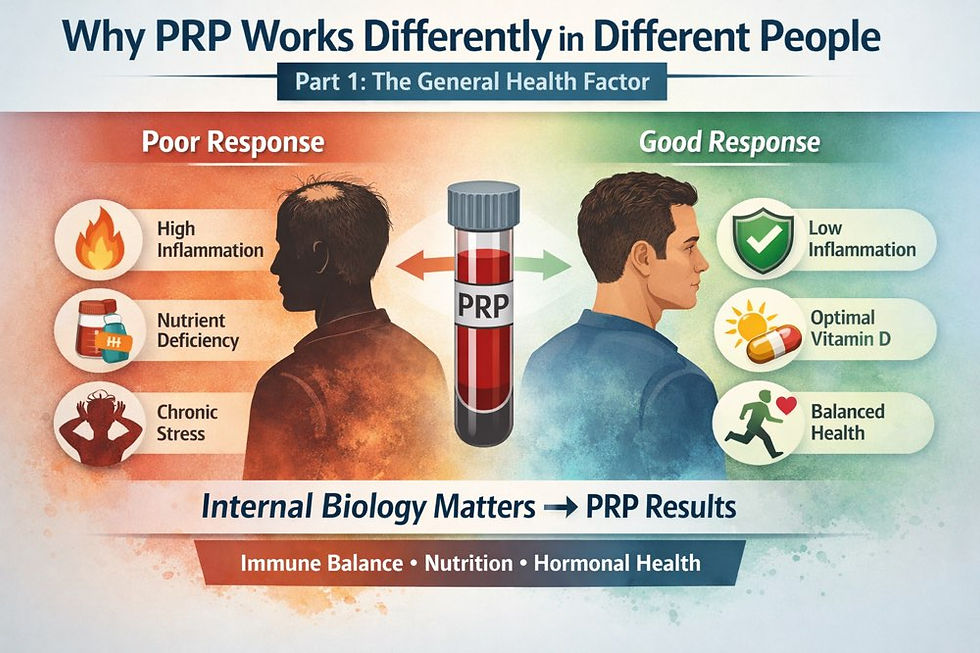
The Patient Matters Too
One of the most important messages in this editorial is that PRP does not function independently from the patient receiving it.
The authors suggest that PRP effectiveness may depend heavily on:
biological age
inflammation levels
lifestyle
overall health
regenerative capacity
This is important because it may help explain why:
two people receiving apparently similar PRP treatments may respond differently
some patients achieve excellent results
others improve only modestly
some may not respond at all
This variability is something honest clinicians should openly acknowledge.
PRP Research Is Still Evolving
The editorial also highlights a major challenge within PRP research itself.
Although many laboratory and early clinical studies are promising, there is still inconsistency between studies and difficulty standardising treatment protocols.
Different clinics and researchers may be:
using different preparation systems
injecting at different depths
selecting patients differently
using different protocols
treating different biological conditions
Yet all of these factors may influence outcomes.
This makes PRP far more complicated to study than a conventional drug trial.
The authors also point out that current PRP therapy still struggles with predicting:
who will respond well
who may respond only modestly
and who may not respond at all
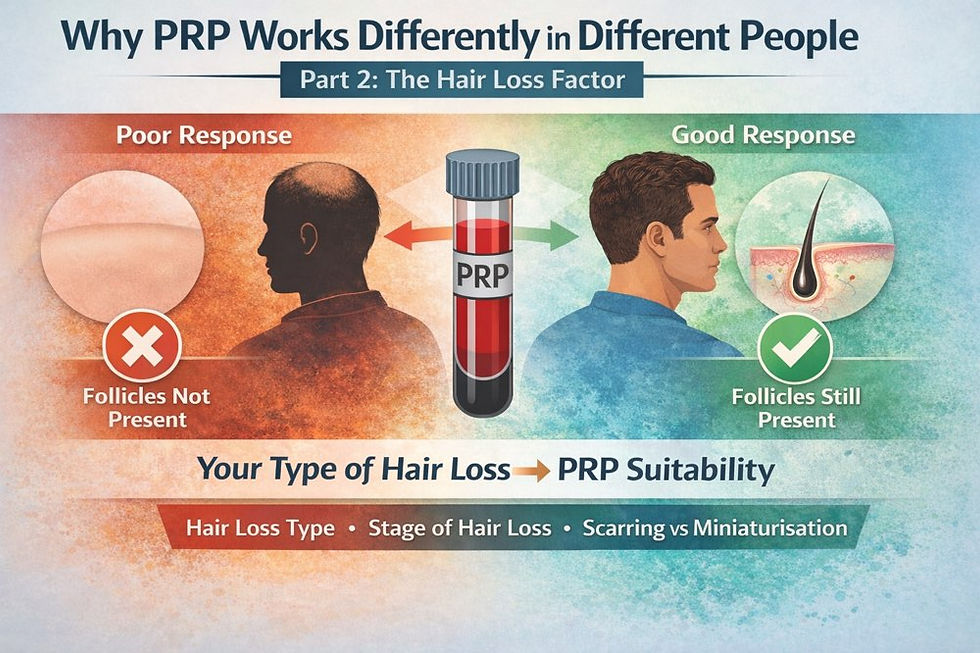
What This Means for Patients with Hair Loss
For patients considering PRP for androgenetic alopecia or other forms of hair loss, I believe this paper reinforces several important points.
1. PRP is real biology - not hype
PRP contains biologically active substances capable of influencing healing, inflammation and tissue signalling.
2. PRP is not universally predictable
No ethical clinician should present PRP as guaranteed or identical in every person.
3. The patient matters
Sleep, inflammation, nutrition, stress, metabolic health and scalp condition may all influence treatment response.
4. Quality matters
Not all PRP systems, protocols or treatment approaches are necessarily equivalent.
5. Hair loss itself is complex
Hair loss is not one condition, it is many. It may involve genetics, hormones, immune signalling, inflammation, ageing and changes within the scalp environment itself.
My View
I believe one of the biggest mistakes in the PRP industry has been oversimplification.
The science increasingly suggests PRP is not a single thing.
It is a highly variable biological therapy interacting with a highly variable human body.
That complexity can sometimes frustrate researchers looking for perfect predictability.
But it may also explain why thoughtful patient selection, careful technique and a broader understanding of regenerative biology matter so much.
Reference
Kawase T, Ushiki T, Mochizuki T. Special Issue “Recent Progress in Regenerative Therapy Using Blood-Derived Biomaterials”. International Journal of Molecular Sciences. 2026;27(7):3095.
Authored by Dr Gwen Adey
First published 03/05/26
Last Updated 25/06/26
Medical Disclaimer
This article is intended for educational purposes only and should not be taken as individual medical advice. If you are experiencing hair loss, speak to a suitably qualified healthcare professional.
Enjoyed this article?
Stay up to date with the latest hair loss research, emerging treatments and practical advice from Dr Gwen Adey.