
Can Alopecia Areata Affect Eyes?

When most people think about alopecia areata affecting the eyes, they think about the loss of eyelashes or eyebrows.
That makes sense. Eyelashes help protect our eyes from dust, debris and excessive airflow, while our eyebrows help divert sweat and rain away from them.
Losing either can leave the eyes feeling dry, irritated or more sensitive.
But could alopecia areata affect the eye itself?
A new systematic review and meta-analysis published in 2026 suggests it might.
More Than Hair Loss
Alopecia areata is an autoimmune condition in which the immune system mistakenly attacks the hair follicle.
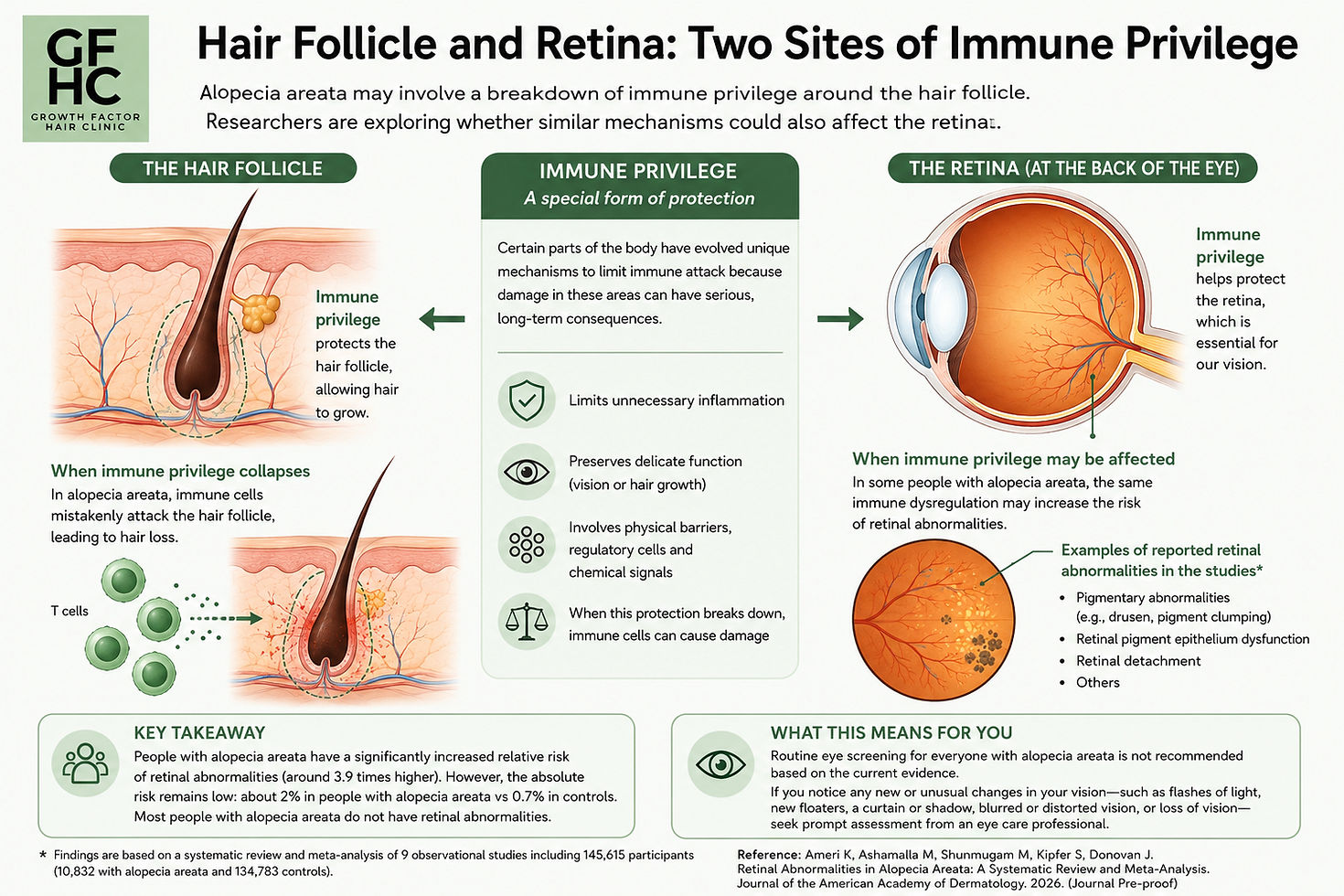
Over the past few decades, researchers have learnt that the hair follicle is normally protected by something called immune privilege. In simple terms, this means the immune system is encouraged to leave it alone.
When that protection breaks down, immune cells can begin attacking the growing hair follicle, leading to hair loss.
Interestingly, the hair follicle isn’t the only part of the body with immune privilege.
Parts of the eye, including the retina, also rely on similar protective mechanisms.
This has led scientists to ask an intriguing question.
If immune privilege collapses around the hair follicle, could similar immune mechanisms occasionally affect the eye?
What Did the Researchers Find?
Researchers combined the results of nine observational studies involving more than 145,000 people, including over 10,000 patients with alopecia areata.
Overall, around 2% of people with alopecia areata were reported to have a retinal abnormality, compared with 0.7% of people without the condition.
After combining the available evidence, people with alopecia areata had approximately 3.9 times the relative risk of retinal abnormalities compared with controls.
That sounds dramatic.
But it’s important to understand what those numbers really mean.
Relative Risk Isn’t the Same as Absolute Risk
Medical headlines often focus on relative risk because it sounds impressive.
A four-fold increase sounds frightening.
However, the absolute numbers remained small.
In this review, approximately 98 out of every 100 people with alopecia areata did not have a reported retinal abnormality.
That’s an important perspective.
This study suggests there may be an association, but it does not mean that most people with alopecia areata will develop eye disease.
Does More Severe Alopecia Mean Greater Risk?
Interestingly, most of the included studies found no clear relationship between the severity or duration of alopecia areata and the likelihood of retinal abnormalities.
This suggests that any increased risk may reflect the underlying immune mechanisms involved in alopecia areata rather than simply how much hair someone has lost.
Should Everyone with Alopecia Areata Have Their Eyes Checked?
Based on the current evidence, probably not.
The authors do not recommend routine ophthalmology screening for everyone with alopecia areata.
Instead, they suggest that people who develop visual symptoms should seek prompt assessment by an eye care professional.
Symptoms You Shouldn’t Ignore
Regardless of whether you have alopecia areata, you should seek urgent assessment if you notice:
Sudden flashes of light.
A sudden shower of new floaters.
A curtain or shadow across your vision.
Sudden blurred or distorted vision.
Persistent loss of vision.
These symptoms have many possible causes, but some retinal conditions require prompt treatment.
Why This Study Matters
To me, the most interesting finding isn’t simply that retinal abnormalities may be more common in alopecia areata.
It’s that this research continues to build our understanding of alopecia areata as a condition involving the immune system rather than simply a condition of the hair.
The hair follicle and the eye share an unusual biological feature: both depend on carefully controlled immune privilege.
Learning why this protection sometimes fails may eventually help researchers develop better treatments—not only for alopecia areata, but perhaps for other immune-mediated diseases as well.
As always, one study rarely changes clinical practice on its own. However, each carefully conducted piece of research helps us understand a little more about one of the most fascinating conditions in dermatology.
Reference


