The History of PRP: How a Healing Treatment Ended Up Helping Treat Hair Loss

Today, platelet-rich plasma (PRP) is used around the world to help treat androgenetic alopecia, more commonly known as male and female pattern hair loss as well as many other conditions.
But PRP was never originally developed as a hair loss treatment.
In fact, if you had told a surgeon in the 1990s that one day concentrated platelets would be injected into scalps to help support hair growth, they might have looked at you rather strangely.
The story of PRP begins somewhere completely different.
It begins with a simple question:
How can we help the body heal itself?
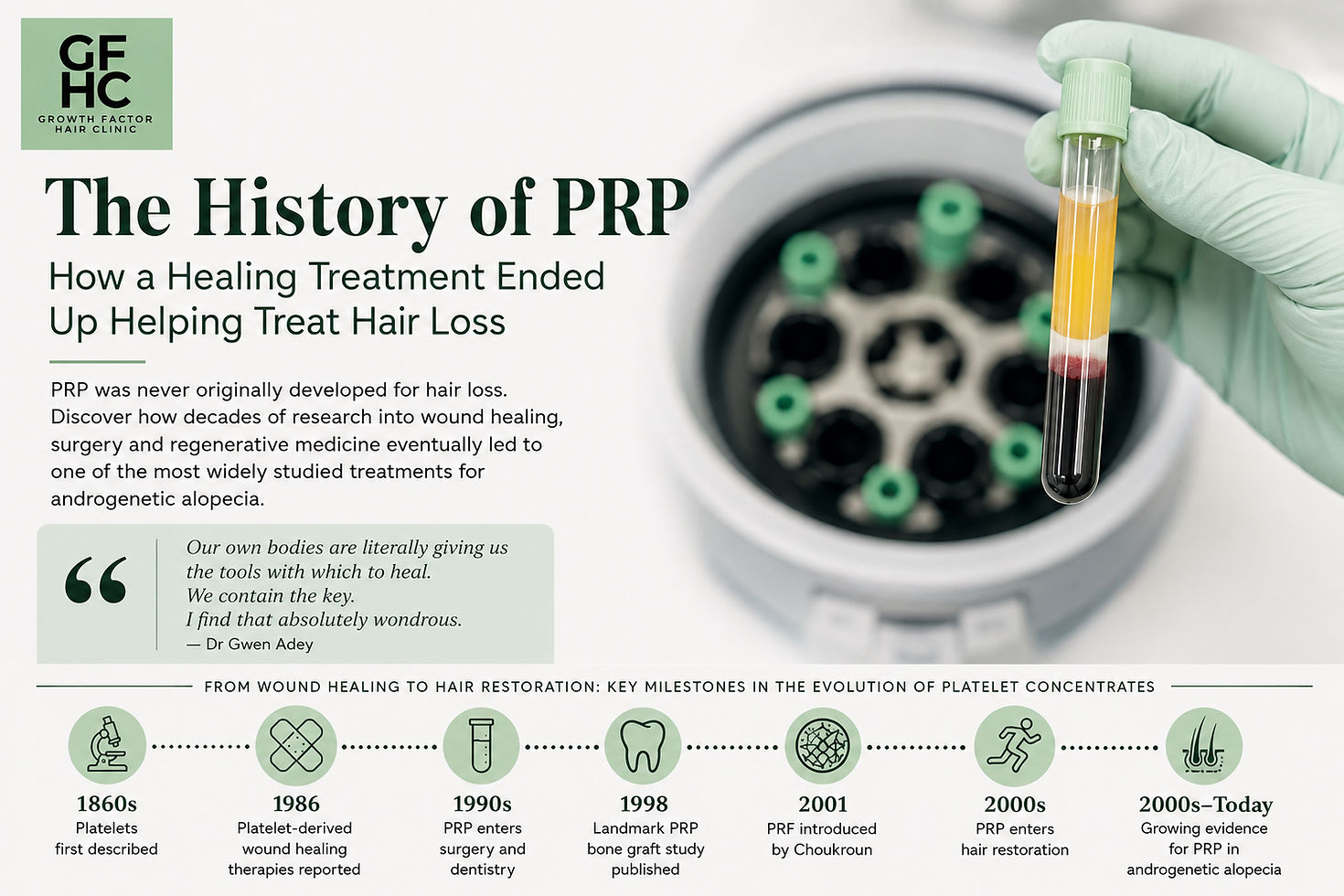
It All Starts with Platelets
Platelets are tiny cells that circulate in your bloodstream. Their most obvious job is to help stop bleeding when you cut yourself.
For many years, scientists believed that was their main purpose.
Then researchers discovered something remarkable.
Platelets don’t just help blood clot. They also release a wide range of biological signals involved in healing and tissue repair.
These signalling molecules help coordinate many of the processes involved in healing damaged tissues.
Suddenly, platelets became much more interesting.
The Early Wound Healing Years
During the 1980s, doctors began experimenting with ways of using platelet-derived products to help wounds heal.
One important milestone came in 1986, when Knighton and colleagues reported the use of platelet-derived wound healing preparations in patients with chronic wounds that were struggling to heal.
The idea was simple.
If platelets naturally help coordinate healing, what would happen if doctors could deliver a higher concentration of them directly to damaged tissues?
The results generated considerable interest and helped lay the foundations for future research.
The Birth of PRP
During the 1990s, researchers developed techniques to concentrate platelets from a patient’s own blood.
A blood sample could be placed into a centrifuge and spun at high speed, separating its different components.
The platelet-rich portion could then be collected.
This became known as Platelet-Rich Plasma, or PRP.
The principle was elegant.
Take the patient’s own blood.
Concentrate the platelets.
Return those concentrated platelets to the area that needs support.
Because the blood came from the patient themselves, there was no risk of rejection.
Clinicians quickly became interested.
Why Surgeons and Dentists Became Interested
One of the most important early developments came in oral and maxillofacial surgery.
In 1998, Marx and colleagues published a landmark paper describing the use of PRP alongside bone grafting procedures.
The study attracted significant attention and helped introduce PRP to a much wider audience.
Over the following years, platelet concentrates began appearing in:
Dentistry
Oral surgery
Orthopaedics
Sports medicine
Wound healing
Regenerative medicine
At this stage, hair restoration was not yet a major focus.
Scientists Realised Not All PRP Was the Same
As PRP became more popular, researchers noticed something important.
Different preparation methods produced different biological products.
Different centrifuges.
Different spinning speeds.
Different tubes.
Different concentrations of cells.
What many people casually referred to as “PRP” could actually vary considerably from one clinic to another.
This led to decades of research into how platelet concentrates could be improved and refined.
In many ways, that work continues today.
The Development of PRF
In 2001, French surgeon Joseph Choukroun introduced a new type of platelet concentrate called Platelet-Rich Fibrin (PRF).
PRF differs from PRP -
it’s a gel, not a liquid and can be stretched to form membranes and may offer slow release properties.
So What Has This Got To Do With Hair Loss?
At first glance, not very much.
But researchers began asking an interesting question.
If platelet concentrates could support healing in other tissues, could they also influence hair follicles?
Hair follicles are not simply strands of hair.
They are living biological structures.
They contain stem cells.
They require blood supply.
They respond to complex chemical signals.
As regenerative medicine expanded during the 2000s and 2010s, researchers began investigating whether platelet concentrates might have a role in hair restoration.
The results were encouraging.
Today, PRP has become one of the most widely studied regenerative treatments for androgenetic alopecia.
Multiple systematic reviews and meta-analyses have shown that many patients experience improvements in hair density, hair thickness and overall hair growth following treatment.
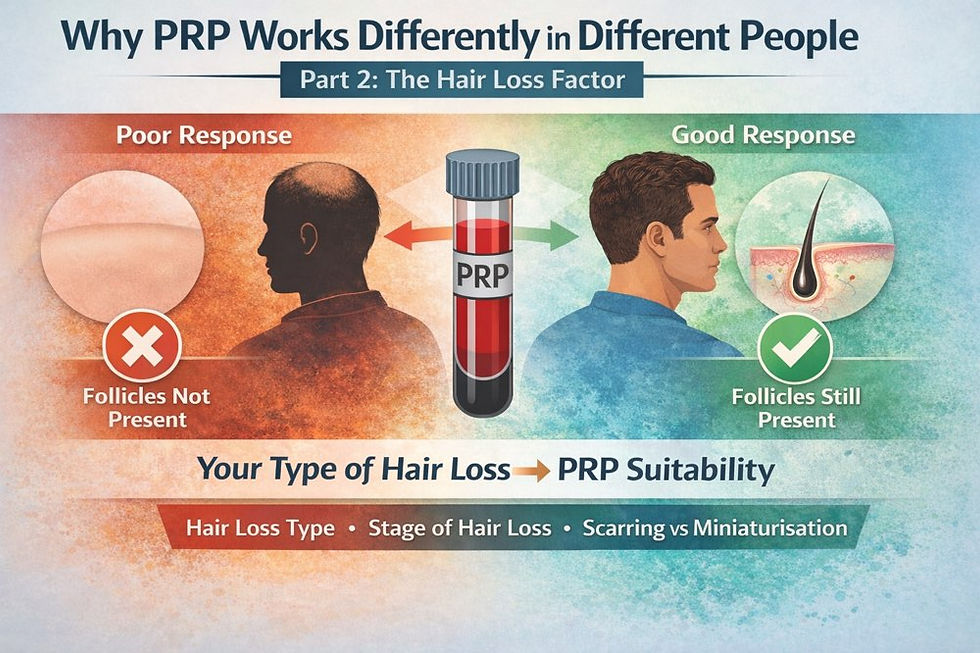
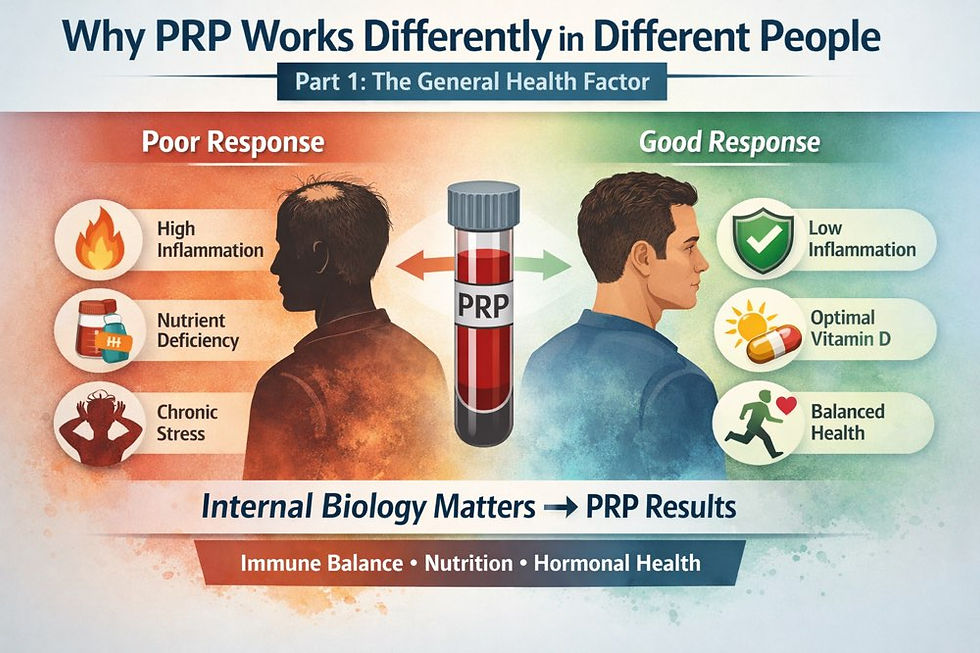
Of course, PRP does not work for everyone.
No treatment does.
However, we have now moved well beyond the question of whether PRP can help androgenetic alopecia at all.
The evidence shows that it can.
The more interesting questions today are which patients are most likely to benefit, how treatments can be optimised, and how outcomes can continue to improve.
One Important Lesson From History
The history of PRP teaches us something important.
PRP was not invented by the hair industry.
It evolved from decades of research into healing, surgery, wound repair and regenerative medicine.
It also teaches us that PRP is not one simple thing.
Scientists have spent more than thirty years refining platelet concentrates because they believe the details matter.
The way blood is processed.
The cells that are included.
The structure of the final product.
The way growth factors are released.
All of these factors may influence how a platelet concentrate behaves in living tissues.
The story of PRP is still being written.
Why I Find PRP So Fascinating
As a clinician, I will never stop being in awe of the power of PRP.
Think about it for a moment.
Your body already contains cells whose job is to help repair and heal damaged tissues.
By taking a small sample of your own blood and concentrating those cells, we are harnessing mechanisms that already exist within you.
Our own bodies are literally giving us the tools with which to heal.
We contain the key.
I find that absolutely wondrous.
The story of PRP is not the story of a pharmaceutical company inventing a new chemical. It is the story of scientists gradually discovering and learning to work with healing systems that were inside us all along.
What started as a treatment designed to support wound healing has evolved into a valuable tool that is now helping many people preserve and improve their hair.
And I suspect the story is far from over.
Authored by Dr Gwen Adey
First published 13/06/26
Enjoyed this article?
Stay up to date with the latest hair loss research, emerging treatments and practical advice from Dr Gwen Adey.
References
Knighton DR, Ciresi KF, Fiegel VD, et al. Classification and Treatment of Chronic Nonhealing Wounds. Annals of Surgery. 1986;204:322-330.
Marx RE, Carlson ER, Eichstaedt RM, et al. Platelet-Rich Plasma: Growth Factor Enhancement for Bone Grafts. Oral Surgery, Oral Medicine, Oral Pathology, Oral Radiology and Endodontology. 1998;85:638-646.
Dohan DM, Choukroun J, Diss A, et al. Platelet-Rich Fibrin: A Second-Generation Platelet Concentrate. Oral Surgery, Oral Medicine, Oral Pathology, Oral Radiology and Endodontology. 2006.
Medical Disclaimer
This article is intended for educational purposes only and should not be taken as individual medical advice. If you are experiencing hair loss, speak to a suitably qualified healthcare professional.